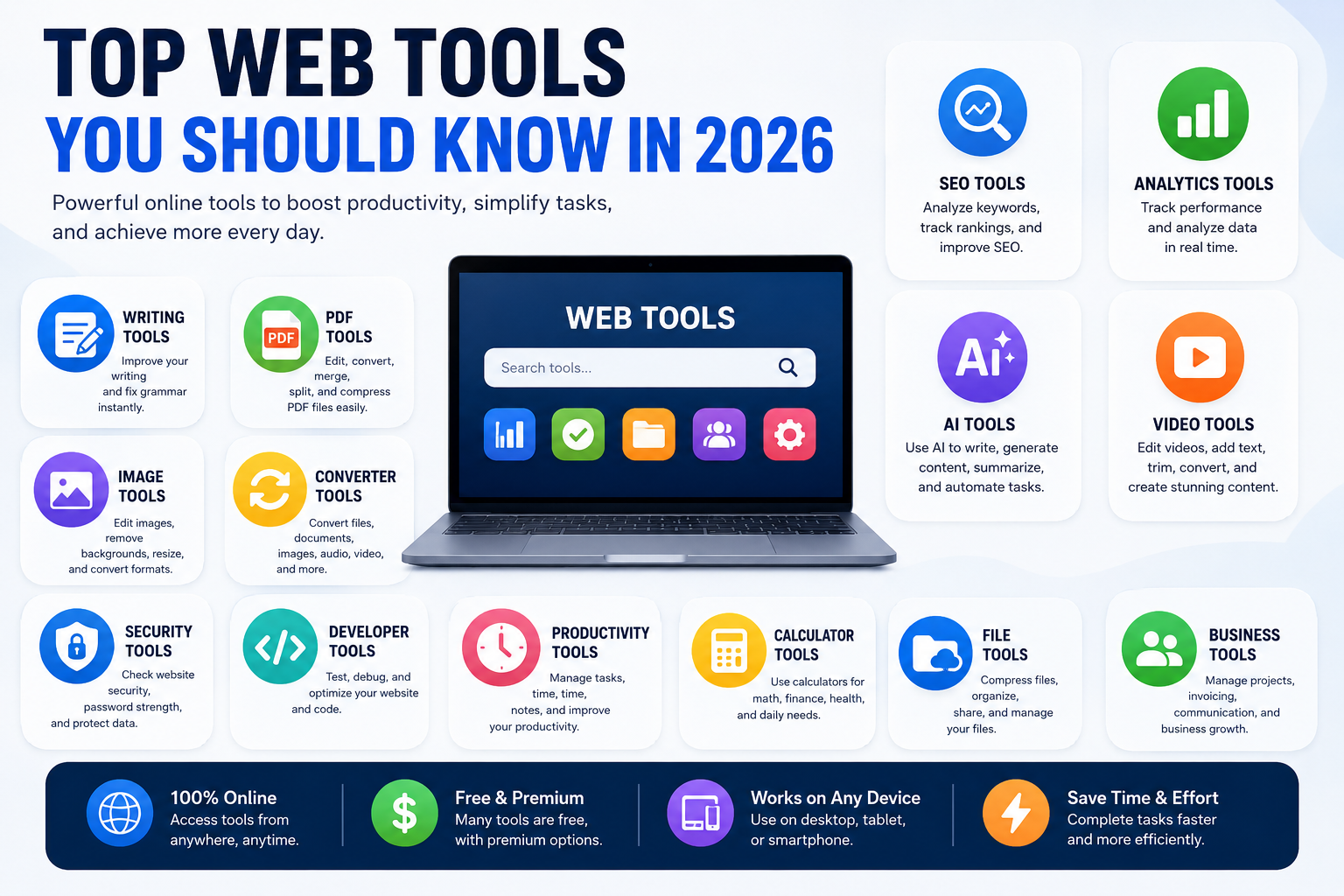
Discover the top web tools you should know in 2026 for productivity, business, SEO, content creation, file management, and everyday online tasks.
The internet has become an essential part of modern life. People use online services every day for communication, work, education, business, entertainment, research, and personal projects. As digital activities continue to grow, web tools have become increasingly important for completing tasks faster and more efficiently.
Web tools are online applications or services that can be accessed through an internet browser. Unlike traditional software, many web tools do not require complicated installation. Users can simply visit a website, select the required function, and complete a task within minutes.
In 2026, there are web tools available for almost every type of digital activity. Users can find tools for writing, image editing, PDF management, SEO, marketing, productivity, business, file conversion, calculations, website testing, and many other purposes.
The challenge is not finding a web tool. The challenge is finding the right one.
What Are Web Tools?
Web tools are online services designed to perform specific functions through a web browser. Some tools are simple utilities, while others provide advanced features for professionals and businesses.
For example, a user may need to convert a PDF document into another format. Instead of downloading dedicated software, an online PDF converter can complete the task directly in a browser.
Similarly, website owners can use online SEO tools to research keywords, analyze competitors, monitor performance, and identify technical problems.
Web tools can be divided into several major categories, including productivity tools, business tools, creative tools, marketing tools, developer tools, security tools, and utility tools.
Why Web Tools Are Important in 2026
The growing popularity of web tools is closely connected to the increasing dependence on digital technology. Remote work, online businesses, digital marketing, content creation, and online education all require users to work efficiently.
Web tools provide several advantages.
First, they are convenient. Most can be accessed from a browser without installing large applications.
Second, many tools work across multiple devices. A user can often access the same service from a desktop computer, laptop, tablet, or smartphone.
Third, web tools can reduce costs. Many platforms provide free versions that are suitable for basic tasks.
Finally, web tools can save time. Tasks that previously required specialized software can often be completed in just a few clicks.
Best Productivity Web Tools
Productivity tools are among the most useful web services available today. They help users organize tasks, manage projects, take notes, create documents, and collaborate with other people.
For individual users, productivity tools can simplify daily planning. A task management platform can help organize priorities and deadlines.
For businesses, productivity platforms can improve teamwork. Employees can share documents, track projects, communicate with colleagues, and manage workflows from a centralized online environment.
The best productivity tools are not necessarily the ones with the largest number of features. A simple platform that is easy to use can often be more effective than a complicated service.
Online Writing Tools
Writing is another area where web tools have become extremely popular.
Students can use online writing tools to check grammar and spelling. Bloggers can use them to improve readability and organize articles. Businesses can use writing platforms to prepare emails, reports, product descriptions, and marketing content.
Modern writing tools may also include AI-assisted features. These features can help users brainstorm ideas, create outlines, summarize information, or improve existing text.
However, users should not depend entirely on automated writing suggestions. Human review remains important because automated systems may misunderstand context or produce information that requires verification.
Image Editing Tools
Images are essential for websites, blogs, social media, online stores, and digital advertising.
Online image editing tools allow users to perform common tasks without installing professional software. These tasks can include cropping, resizing, compressing, changing image formats, adding text, and removing backgrounds.
For website owners, image compression tools can also be useful because large images may affect page loading speed.
Content creators can use online design platforms to create thumbnails, social media graphics, banners, and promotional materials.
The accessibility of these tools means that even beginners can create attractive visual content.
PDF and Document Tools
PDF files remain one of the most common document formats used online.
Businesses use PDFs for contracts, reports, invoices, presentations, and forms. Students use them for assignments and research materials.
Online PDF tools can help users merge files, split pages, compress documents, convert formats, and perform other common tasks.
One major advantage is convenience. Users do not always need expensive document software for simple PDF operations.
However, privacy should be considered when uploading documents. Sensitive information should only be processed using services that users trust.
SEO Web Tools
Website owners and digital marketers rely heavily on SEO tools.
SEO tools can help users research keywords, analyze competitors, monitor rankings, check backlinks, and identify technical website problems.
Keyword research is particularly important because it helps website owners understand what people are searching for.
Technical SEO tools can identify issues such as slow pages, broken links, missing metadata, and mobile usability problems.
However, SEO tools should be treated as sources of information rather than automatic solutions. A successful SEO strategy still requires useful content, good website structure, strong user experience, and consistent optimization.
AI Web Tools
Artificial intelligence has become one of the biggest developments in the web tools industry.
AI-powered services can assist with writing, research, brainstorming, image creation, data analysis, customer support, and automation.
Businesses can use AI tools to reduce repetitive tasks. Content creators can use them to generate ideas. Developers can use AI-assisted services during software development.
The key is to use AI responsibly.
Important information should be reviewed before publication or business use. Users should also be careful about entering confidential information into third-party AI services.
Online File Conversion Tools
File conversion is a common problem for internet users.
A person may receive a document in an incompatible format or need to convert an image into a different file type.
Online file conversion tools can solve these problems quickly.
Popular conversion tasks include document conversion, PDF conversion, image conversion, audio conversion, and video conversion.
When choosing a converter, users should consider supported formats, maximum file size, conversion speed, and privacy policies.
Website Testing Tools
Website owners should regularly test their websites.
Website testing tools can provide information about loading speed, mobile compatibility, accessibility, and other technical factors.
A website that loads slowly may provide a poor user experience. Similarly, a website that does not work correctly on mobile devices can lose visitors.
Testing tools help developers identify problems and make improvements.
Regular testing is especially important after major website updates, theme changes, plugin installations, or server migrations.
Online Security Tools
Internet users also need tools that help them maintain better online security.
Security-related web tools can help users evaluate passwords, check suspicious links, identify security issues, and learn about potential online threats.
However, tools alone cannot provide complete protection.
Users should also create strong passwords, enable multi-factor authentication, keep software updated, and avoid suspicious links.
Security awareness remains one of the most important parts of safe internet usage.
Free Web Tools vs Paid Tools
One of the biggest advantages of web tools is the large number of free options.
Free tools are useful for students, beginners, freelancers, and small businesses.
However, free versions may have limitations. These can include advertisements, limited usage, smaller file sizes, fewer features, or restricted access.
Paid plans may provide advanced features, higher limits, better support, and additional integrations.
The best choice depends on how frequently the tool is used and how important its features are.
How to Choose the Right Web Tool
Choosing the right web tool requires more than simply selecting the first result in a search engine.
Users should consider several factors.
First, determine the exact problem that needs to be solved.
Second, compare available features.
Third, check whether the tool is easy to use.
Fourth, consider pricing and usage limits.
Fifth, review privacy and security information.
Finally, consider whether the tool will continue to meet future needs.
A tool that solves one problem efficiently can be more valuable than a platform with hundreds of unnecessary features.
Benefits for Businesses
Businesses can benefit significantly from web tools.
Small companies can use online services to manage marketing, documents, customer communication, projects, and financial operations.
Web-based tools can also support remote teams because employees can access information from different locations.
For startups, free or affordable web tools can reduce initial technology expenses.
As a business grows, premium tools can provide additional automation, reporting, integrations, and collaboration features.
Benefits for Content Creators
Content creators have access to an enormous selection of online tools.
Writers can use editing and research tools. Designers can use online graphics platforms. Video creators can use browser-based editors.
Social media creators can use tools for image resizing, content planning, caption generation, and analytics.
Using the right tools allows creators to spend less time on repetitive technical tasks and more time developing creative ideas.
The Future of Web Tools
The web tools industry is likely to continue evolving rapidly.
AI will probably become more integrated into everyday online services. Automation will become more accessible, and web applications will continue replacing some traditional desktop software.
Users can also expect more specialized tools designed for specific industries and professional tasks.
As technology develops, choosing reliable and useful tools will become increasingly important.
The goal should not be to collect as many tools as possible. Instead, users should build a small collection of trusted services that solve their most important problems.
Conclusion
Web tools have become an important part of modern digital life. From productivity and writing to SEO, image editing, PDF management, security, and artificial intelligence, there is now an online solution for almost every common digital task.
The best web tools are those that save time, simplify complicated processes, and provide useful results.
Whether you are a student, professional, entrepreneur, marketer, developer, or content creator, learning how to use the right web tools can significantly improve your digital workflow.
In 2026, knowing which online tools to use is no longer just a convenience. It can be an important part of working smarter and staying productive in an increasingly digital world.